“To cross the Ponte Vecchio, the famous double-tiered bridge from which Dante dreamed of Beatrice, his muse for The Divine Comedy, is to pass into another time.”
— Robert M. Edsel, Saving Italy
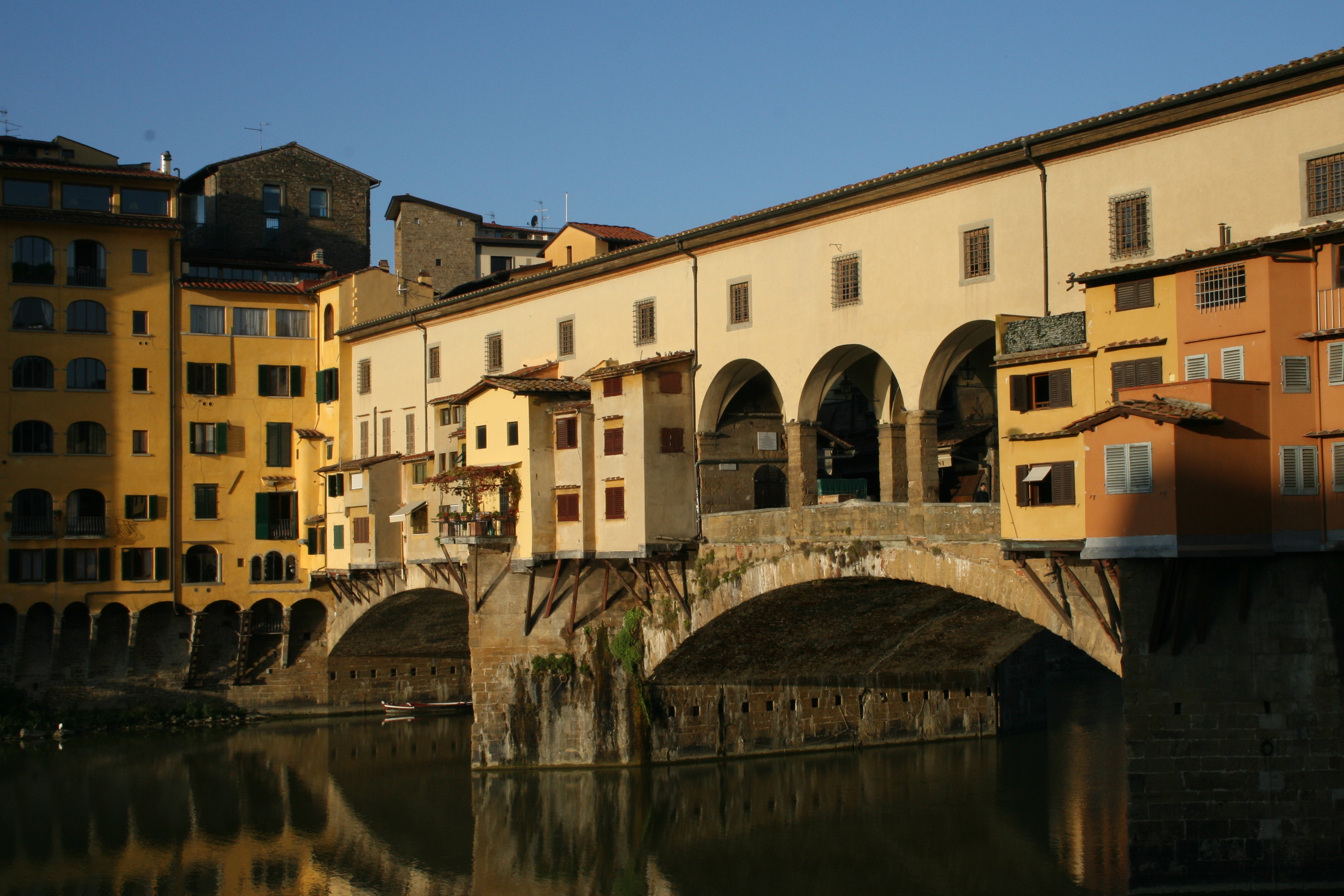
Ponte Vecchio, Florence’s old bridge, is one of the most recognizable and photographed bridges in the world. Its crush of vibrant but mismatched jewelry shops (retrobotteghe), tacked on to the bridge’s side like an afterthought, are its characteristic essence.
It is believed that a bridge has spanned the spot where the Ponte Vecchio stands today — at the narrowest section of the river — since Florence’s ancient Roman beginnings, when the road was known as via Cassia and linked Rome to Paris. The bridge provided passage over the Arno, making the lengthy journey between the two cities — nearly 700 miles — possible. Amazingly, the Ponte Vecchio we see today, while not the bridge of the ancient Romans, is the one which has stood since 1345.
But on a wartime night in August of 1944, the historic bridges of Florence were bombed, destroyed as German forces fled the city.
Ponte Vecchio was the only bridge spared. Why would it not suffer the same fate as the other fallen ponti? Stories vary.
Hitler was notably fond of Florence, calling the city the “jewel of Europe,” and even commenting to one of his ambassadors in late 1943, “Florence is too beautiful a city to destroy. Do what you can to protect it: you have my permission and assistance.” 1 Instructions for Operation Feuerzauber, codename for the Florence bridge destruction operation, “called for the destruction of all bridges ‘in and near Florence’ except for the Ponte Vecchio.”2
Sentimentality from a ruthless dictator? I’m skeptical, despite what the historical record seems to show.
Another angle I’ve read is plausible: the Ponte Vecchio was left alone because the Germans knew it simply could not support the weight of Allied tanks traversing it. There was no need to bomb the Ponte Vecchio, considering that all other bridges were destroyed and this last one standing would not be strong enough to allow vehicles to cross over the central part of the city anyhow. Demolished in its place, however, were adjacent historic buildings and streets, leaving enough devastation and rubble to render the bridge useless to liberating Allied forces, who would arrive the day after the bombings.
The Ponte Vecchio was ultimately saved, it seems — or rather, not destroyed — by order of Field Commander Albert Kesselring, the Nazi officer overseeing the war campaign in Florence. Kesselring was already stinging from Hitler’s fury for Kesselring’s retreat from Rome without destroying their bridges. However, even though “Kesselring felt great ‘psychological pressure’ from Hitler concerning the fate of the bridges of Florence,” writes Robert M. Edsel in Saving Italy, “Hitler made it clear that under no circumstances was Kesselring to destroy the city’s bridges, adding: ‘Their artistic and historical value should be respected, the military disadvantages, which should not be overestimated, [are] to be accepted.'”
Ultimately, Kesselring made the final call: destroy the bridges, save the Ponte Vecchio but cause enough periphery damage to the streets and homes leading up to the old bridge to render it impassable. And that is exactly what happened on the night between August 3 and 4, 1944, during Operation Feuerzauber (magic fire), under Kesselring’s command. After the war, Kesselring suffered the fate of many of surviving Nazi officers: he was eventually convicted of war crimes, sentenced first to death, later commuted to life in prison, but finally released in 1952. He lived another eight years before dying in West Germany.
Another possibility for Ponte Vecchio’s survival has emerged of late, due to a recently discovered letter which suggests “that a brave shop assistant may have disabled the mines placed on the Ponte Vecchio, preventing its destruction.”3

But, in reflecting upon the order of events involving Kesselring, who then, is Gerhard Wolf, and why is there a plaque with his name on it on the Ponte Vecchio, offering up these words from a grateful nation: “per la salvezza del Ponte Vecchio (1944)” — for the salvation of the Ponte Vecchio?
The short explanation is found in the plaque’s inscription, translated: “Gerhard Wolf (1886–1962). German consul, born at Dresden—subsequently twinned with the city of Florence—played a decisive role in the salvation of the Ponte Vecchio (1944) from the barbarism of the Second World War and was instrumental in rescuing political prisoners and Jews from persecution at the height of the Nazi occupation. The commune places this plaque on 11 April 2007 in memory of the granting of honorary citizenship.”
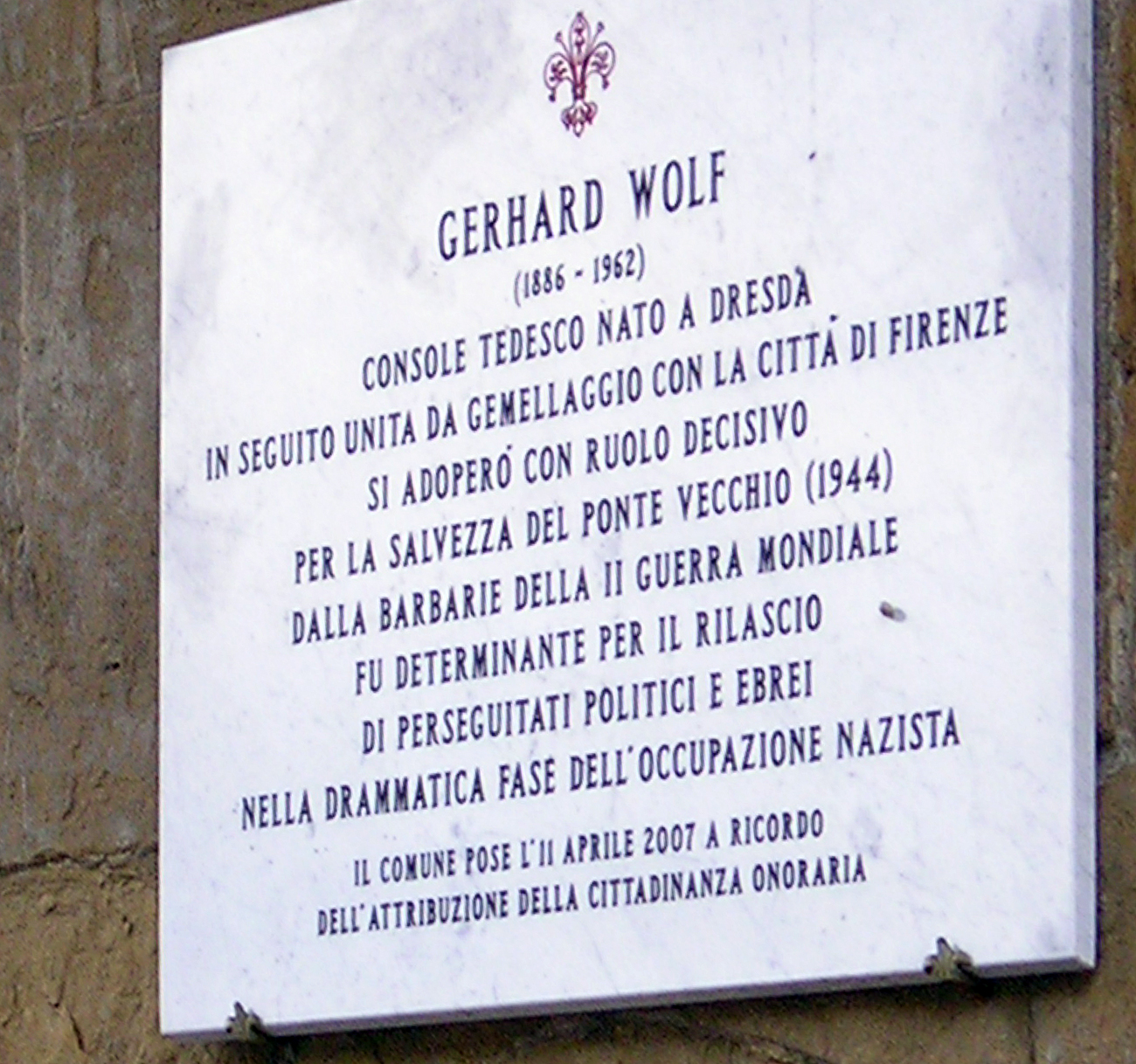
Wolf was a German diplomat, working in Rome in 1933 during Hitler’s rise to power. Unable to avoid joining the Nazi party entirely and continue his foreign ministry work, he found a compromise as the German Consul to Florence. This provided some separation from the party and, in this role, along with a small group of men which included the Swiss Consul and the Archbishop of Florence, Wolf worked tirelessly to save Florence and its treasures from the destruction of the war. Even though the bridges were destroyed by the Nazis, much of Florence’s artwork and landmarks were spared. Wolf also used his status to free political prisoners held by Italian fascists and in some instances, forge documents for Florentine Jewish citizens working to escape the city.
In 1955, Wolf was named an honorary citizen of Florence. He died in Munich in 1971 at the age of 74. He was honored posthumously in 2007 with the plaque on the Ponte Vecchio; the old bridge still steadfast and strong after nearly seven hundred years, a medieval witness to centuries of Florence’s intricate history.
Sources
- Saving Italy by Robert M. Edsel
- Florence: The Biography of a City by Christopher Hibbert
- The Local
- Image Credit: Ponte Vecchio 1944
- Image Credit: Gerhard Wolf
Footnotes
- Saving Italyl ↩︎
- Saving Italy ↩︎
- SmartHistory ↩︎
 Prayers & Piazzas
Very interesting! Florence is indeed a beautiful city and love that bridge. We had a lovely view from our hotel many years ago. Thank you, Stacy!
Ciao Patty and thank you! ❤️
Love this! So amazing that this beautiful, historic bridge is still standing! Can’t wait to one day see it in person! 🥰